This is a response to Marica's post What is this world coming to?! which can be viewed at http://marica-christianityandpopularculture.blogspot.com/2011/03/what-is-this-world-coming-to.html
I completely agree with Marica's point that violence has completely integrated into contemporary society. It is almost impossible to not to come across some form of violence when we watch t.v. or movies. Violence is even in cartoons. My favourite cartoons to watch when I was a kid was Looney Tunes. I loved Bugs Bunny. However, Bugs was constantly trying to running away from Elmer Fudd, who happens to have a shotgun. Other characters on the show such as Wild E. Coyote, and Yosemite Sam, were always carrying some form of weaponry. Although the aforementioned characters always fail comically, shooting guns and throwing dynamite at other creatures is a form of violence nonetheless.
But what about violence in religion? Throughout history, there have been many instances of violent religious acts. From the crusades to suicide bombers, these violent acts are conducted in the name of God. Trothen makes the argument that the Christian religion is founded on an act of violence. Yet, we see little complaints of violence in religion. When a movie is too gory, we slap on a R-rating. But when a "preacher" call for the burning of the Qu'ran, or for the death of "infidels", we can see children attending the sermon. I think it is much more likely for a person to conduct violent acts with a religious motivation than it is to conduct that same act based on a tv show. Would a child be more likely to steal a car because of a video game, or would this child be more likely to hate on someone who does not share his beliefs because "the other person works on behalf of the devil"?
Sunday, April 17, 2011

Monday, April 11, 2011
I am Weebus, God of Azeroth
This is a semi-response to Elona's post "Jersey Shore and Dustin Kidd" which can be viewed at http://ekhoy.blogspot.com/2011/01/jersey-shore-and-dustin-kidd-normal-0.html
Creating Norms: When I was a child, hanging out would mean going outside to play with your friends. With the advent of CS, hanging out was soon relocated to the internet cafe, where kids would spend hours playing CS online with their friends. I think I've played de_dust so much I have the map ingrained into my brian. I still remember all the best camping spots. More importantly, I think these games have made gaming more acceptable. Popular Hollywood stars such as Mila Kunis admit that they play World of Warcraft.
Maintaining Boundaries: As an ex-World of Warcraft player, I can honestly say that I could strike up a conversation with anyone that played WOW. Sometimes when I tell non-WOW players that I play the game, I would often receive "Oh, you're one of those" responses. Video game players are often labeled as anti-social and nerdy or geeky. Furthermore, these games have developed slang that only gamers use such as gg (good game), and camping (a spot on the map where it is hard to kill you but easy to pick off enemies).
 |
| de_dust |
Developing Rituals: Similar to people bonding while watching a tv show or participating in sports, gamers bond virtually, and if you're playing with friends, you can bon in reality too! In WOW, there are events called "raids" where anywhere from 5 - 30 characters participate. Before each of these raids, every group goes through the same ritual: checking that all gear is repaired, and developing a game plan. It is similar to pre-game rituals seen in hockey or football.
Innovation: CS and WOW both made gaming acceptable in the mainstream. Furthermore, within the gaming world, both these games are extremely innovative in the way they have developed gameplay. CS for its multi-player online first-person shooter, and WOW for its subscription massively multi-player online role playing game.
Social Change: As stated above, both CS and WOW have helped gaming to the point where there is a professional league which is sometimes show on Sportsnet. WOW has even made and appearance on South Park. Furthermore, some slang such as noob (slang for newbie) are now commonly used.

WOW is designed so that it is almost a reflection of the real world. Within the virtual world, we can find different organizations (guilds) with people from all socio-economic classes from all over the world. I once met a Ph.D. student on WOW who was doing his thesis on the similarities between the WOW economy and the economic structure of the "real world". By applying effective real world economic theories on the WOW economy, he actually managed to make alot of money. This just goes to show how immersive the game can be. Events such as raids, create a sense of community and a develop strong emotions similar to those experienced during a sporting event. No joke, I have witnessed families breaking up because of World of Warcraft.
Response to Jesus is my Facebook Friend
This is a response to Dan's post "Jesus is my Facebook Friend" which can be viewed at http://lambgd.blogspot.com/2011/04/jesus-is-my-facebook-friend.html
I really liked Dan't article on Christians and the internet. I had no idea that there was something called "Godtube" or Christians only dating sites. Without going to the site, I would assume that Godtube would be a website some crazy Christian nut made in his basement, but it is actually surprisingly well done. There are even ads before videos similar to what happens on Youtube when you try and watch VEVO videos. Except these ads are for Christian music instead of Old Spice or GM (as soon as I write this an ad for Liberty University pops up on Godtube). While I'm on the subject of Christian music, I can see some parallels developing between the trend of Christian websites and Contemporary Christian Music (CCM). In Brian Schill's article, he describes the formation of the CCM genre as a way to stand out from the mainstream. However, because of the characteristics of the music industry (e.g. trying to become as popular as possible), there will be a point where CCM will be accepted into the mainstream, defeating its original purpose. I can see the same thing happening with Christian websites such as Godtube, which was created as an alternative (or the Other) to popular video sharing sites such as Youtube or Vimeo. At what point will these websites join into the internet mainstream? But at the same time, there is also a fundamental difference between the music industry and the internet, and that is the economics of the respective industries. It is much cheaper to maintain a domain of the web than a record company. Because of this, it is not necessary for websites increase visitors (although it might be better for them to do so). Therefore, a niche website such as Godtube may never become completely mainstream, just popular within the niche its designed for. And speaking of niches, here is a random video of Justin Bieber I found on Godtube.
I really liked Dan't article on Christians and the internet. I had no idea that there was something called "Godtube" or Christians only dating sites. Without going to the site, I would assume that Godtube would be a website some crazy Christian nut made in his basement, but it is actually surprisingly well done. There are even ads before videos similar to what happens on Youtube when you try and watch VEVO videos. Except these ads are for Christian music instead of Old Spice or GM (as soon as I write this an ad for Liberty University pops up on Godtube). While I'm on the subject of Christian music, I can see some parallels developing between the trend of Christian websites and Contemporary Christian Music (CCM). In Brian Schill's article, he describes the formation of the CCM genre as a way to stand out from the mainstream. However, because of the characteristics of the music industry (e.g. trying to become as popular as possible), there will be a point where CCM will be accepted into the mainstream, defeating its original purpose. I can see the same thing happening with Christian websites such as Godtube, which was created as an alternative (or the Other) to popular video sharing sites such as Youtube or Vimeo. At what point will these websites join into the internet mainstream? But at the same time, there is also a fundamental difference between the music industry and the internet, and that is the economics of the respective industries. It is much cheaper to maintain a domain of the web than a record company. Because of this, it is not necessary for websites increase visitors (although it might be better for them to do so). Therefore, a niche website such as Godtube may never become completely mainstream, just popular within the niche its designed for. And speaking of niches, here is a random video of Justin Bieber I found on Godtube.
Sunday, April 10, 2011
Is Pop Culture Based on Music?
This is a response to Kathleen's post which can be viewed at http://lifeisbetterinblackandwhite.blogspot.com/2011/03/response-to-dianas-commit-crime-do-time.html.
I agree that Hip Hop has become increasingly violent in its lyrical content. However, as most rappers will say that the content of their music is based on their life experiences, is their music a reflection of our culture today, or does their music dictate our culture? I would argue that these 'gangsta' rappers are just giving the public what they want. If the world was not interested in sex and drugs, then why would they listen to these songs? There is no doubt that the world is more liberal than it was 10 or 20 years ago. Music videos on tv today would be banned 20 years ago. And here is an alternative view on music history. In the 70's and 80's it was all about "sex, drugs and rock'n roll", now its been changed to "sex, drugs and hip hop". Yet, for some reason, rap has been taking all the blame. Most of the time, its from the same people who indulged in the rock and roll culture back in the 70s, 80s and 90s. One of the greatest rock musicians of all time, Kurt Cobain, died from a drug overdose, yet the masses are up in arms when Snoop Dogg raps that he "gets high everyday"? This seems like hypocrisy at the highest level. And if these 'gangsta' rappers are telling the truth (which I doubt), then isn't there something wrong with our society when people can carry guns, pimp women, and take drugs without repercussions?
I agree that Hip Hop has become increasingly violent in its lyrical content. However, as most rappers will say that the content of their music is based on their life experiences, is their music a reflection of our culture today, or does their music dictate our culture? I would argue that these 'gangsta' rappers are just giving the public what they want. If the world was not interested in sex and drugs, then why would they listen to these songs? There is no doubt that the world is more liberal than it was 10 or 20 years ago. Music videos on tv today would be banned 20 years ago. And here is an alternative view on music history. In the 70's and 80's it was all about "sex, drugs and rock'n roll", now its been changed to "sex, drugs and hip hop". Yet, for some reason, rap has been taking all the blame. Most of the time, its from the same people who indulged in the rock and roll culture back in the 70s, 80s and 90s. One of the greatest rock musicians of all time, Kurt Cobain, died from a drug overdose, yet the masses are up in arms when Snoop Dogg raps that he "gets high everyday"? This seems like hypocrisy at the highest level. And if these 'gangsta' rappers are telling the truth (which I doubt), then isn't there something wrong with our society when people can carry guns, pimp women, and take drugs without repercussions?
Friday, April 8, 2011
Sounds of Christ
I love music. Whenever I'm feeling happy or sad or angry or disappointed, I listen to music. I enjoy all genres but my favourites are house and hip hop. Although the links between these two genres may not be as obvious as a genres such as rock, there are some Christian content in house and hip hop. The emotions experienced during a rave and a techno concert can be compared to the emotions experienced during a sporting event. The same sense of euphoria and community can be felt during a rave or at a packed Swedish House Mafia Concert. Instead of 30,000 people packed into a stadium to watch a few men beat each other up, raves are smaller, but the one DJ (or multiple DJs depending on the event) is located on a raised stage, almost like an idol or a supreme being, dictating to movements of the people below him/her. At most of these raves, there is copious use of drugs, meant to induce a sense of euphoria, a sense of transcendence.
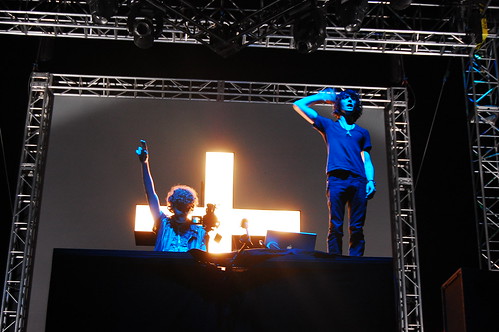 |
| The group Justice, whose logo is a cross |
On the other hand, hip hop, has a strong connection with the Christian tradition. Most hip hop artists come from a Christian background. The roots of hip hop is blues, which is also strongly rooted in the Christian tradition. Hip hop has been criticized by some mainstream media for being overly violent and degrading to women. Unfortunately, it is the small 5%-10% that draws the criticism. One of my favourite songs in by a group called Blu & Exile titled "The World is...(Below the Heavens)". (http://www.youtube.com/watch?v=zKhA5aaCb-Y). The song talks about Blu's upbringing in a Christian household, and his ideas of Heaven. One of the most inspirational songs I've ever listened to.
"Hell is what you choose to call the present, that's why you're going through it, I just choose to call it stressin', to tell you fools the truth I don't feel that why I'm destined, so you can call it hell but bro, I'll just say I'm below the heavens"
Thursday, April 7, 2011
Religion: New and Improved!

Although this topic was discussed in class a long time ago, for this post, I would like to talk about advertising. In class, we learned that advertising had its roots in Christian culture, as most people who get into this industry are Christian men. However, with advertising aimed at our spiritual senses and brands have almost a cult following (Apple), advertising is employing more and more religious tactics to spread their message. But what about religion using advertising for their own gain?
Response to In the name of Kevin, the Nick, and the Holy Joe: Purity Rings Amen!
This post is a response to Arianna's post "In the name of Kevin, the Nick, and the Holy Joe: Purity Rings Amen!" which can be viewed at http://across-the-christian-universe.blogspot.com/2011/04/in-name-of-kevin-nick-and-holy-joe.html
I think Arianna's post brings light on another pop culture phenomenon that originated from Christian traditions: the purity ring. I remember when purity rings (or promise rings) were all the rage when celebrities such as the Jonas Brothers and Miley Cyrus conspicuously wore them to various events. As Miley once said, she wears the purity ring to "promote Christian values and chastity". Although abstinence is promoted as an alternative to contraception, is abstinence a viable solution to preventing teen pregnancies in this day and age? A quick search on google for "jonas bothers purity ring" or "miley cyrus purity ring" will yield a large number of results....most of it from 2008. What about the purity rings now? Are they still wearing them?
According to the celebrity blogs I found, one of the jonas brothers is married, so he took it off. But apparently one of them stopped wearing his after dating an actress (link: http://www.hollyscoop.com/joe-jonas/joe-jonas-ditches-purity-ring-for-ashley-greene_25053.aspx) And Miley's purity ring (according to most tabloids) is highly suspect. It seems that abstinence is not very effective to combat teenage hormones. A more effective way to decrease the amount of teenage pregnancies is through sex ed, and practicing safe sex. And on the subject of purity rings, did you know that Britney Spears had one?
I think Arianna's post brings light on another pop culture phenomenon that originated from Christian traditions: the purity ring. I remember when purity rings (or promise rings) were all the rage when celebrities such as the Jonas Brothers and Miley Cyrus conspicuously wore them to various events. As Miley once said, she wears the purity ring to "promote Christian values and chastity". Although abstinence is promoted as an alternative to contraception, is abstinence a viable solution to preventing teen pregnancies in this day and age? A quick search on google for "jonas bothers purity ring" or "miley cyrus purity ring" will yield a large number of results....most of it from 2008. What about the purity rings now? Are they still wearing them?
According to the celebrity blogs I found, one of the jonas brothers is married, so he took it off. But apparently one of them stopped wearing his after dating an actress (link: http://www.hollyscoop.com/joe-jonas/joe-jonas-ditches-purity-ring-for-ashley-greene_25053.aspx) And Miley's purity ring (according to most tabloids) is highly suspect. It seems that abstinence is not very effective to combat teenage hormones. A more effective way to decrease the amount of teenage pregnancies is through sex ed, and practicing safe sex. And on the subject of purity rings, did you know that Britney Spears had one?
Wednesday, April 6, 2011
Jesus in Television
Personally, I'm not that big of a film person. I enjoy watching television shows much more because most tv shows are around 30mins to 1 hour long so I don't have to invest so much time into them. Although we have covered Christ-figures in film, not much have been discussed when it come to Christ-figures in television. In some shows, the transition is quite obvious. For example, if Superman is seen as a Christ-figure, then the transition of the Christ figure from Superman the movie to Smallville (a show based on the Superman character) is pretty obvious. The characters share the same traits. However, there is a type of Christ-figure that is present in television but not so much in films: the comedic Christ-figure.
The comedic Christ-figure is literally Jesus. This figure is primarily present in animated series such as Family Guy, American Dad, and South Park. The role of the Jesus character is look at the Christian culture (specifically in the US) in a humorous manner. I think a comedic Christ figure is more accepted in these types of television shows because we expect shows such as Family Guy to produce humor which cross boundaries and offend us. If a show such as CSI or even Jersey Shore attempted to make fun of Christianity or Jesus Christ, the network will be receiving obscene amounts of complaints. Actually, now that I think about it, I'm pretty sure FOX is receiving tons of complaints about Family Guy already.
The comedic Christ-figure is literally Jesus. This figure is primarily present in animated series such as Family Guy, American Dad, and South Park. The role of the Jesus character is look at the Christian culture (specifically in the US) in a humorous manner. I think a comedic Christ figure is more accepted in these types of television shows because we expect shows such as Family Guy to produce humor which cross boundaries and offend us. If a show such as CSI or even Jersey Shore attempted to make fun of Christianity or Jesus Christ, the network will be receiving obscene amounts of complaints. Actually, now that I think about it, I'm pretty sure FOX is receiving tons of complaints about Family Guy already.
Response to Perversion of the Church
This is a response to Dan Seljak's post "Perversion of the Church" which can be viewed at http://lambgd.blogspot.com/2011/03/perversion-of-church.html
Dan's post inspired me to think about a type of horror that deals directly with Christian traditions more than any type of vampires, or zombie: the exorcism. I have to admit that one of the scariest films I have seen is The Exorcism of Emily Rose. The movie tells the story of a priest who performed an exorcism on a woman named Emily Rose, who died from the rituals performed during the exorcism. Through out the movie, there are many religious symbols used to portray a sense of horror in the viewer. One example of this is 3AM as the "satan's hour". Coincidentally, the night after I watched to movie, I happened to wake up at 2:50AM and was scared half to death. But this is my point, personally, as a religious person, I believe that this type of "spiritual intervention" if you will, is more realistic than being bit by a vampire, or attacked by a mummy. I think that there is a reason why horror films such as The Grudge and The Ring. The effects of something that we can't see is much more frightening because we cannot visualize defeating or getting rid of the spirit/curse (I can easily see myself grabbing a desk and smashing it into a zombie's head). The difference between monster movies and spiritual hauntings/curses is that the latter utilizes the fear already present in our minds, whereas the former is more shock fear (e.g. something jumping out really fast, or tons of blood). Personally, if I wanted to be scared, I would watch The Ring over 28 Days Later anytime.
Dan's post inspired me to think about a type of horror that deals directly with Christian traditions more than any type of vampires, or zombie: the exorcism. I have to admit that one of the scariest films I have seen is The Exorcism of Emily Rose. The movie tells the story of a priest who performed an exorcism on a woman named Emily Rose, who died from the rituals performed during the exorcism. Through out the movie, there are many religious symbols used to portray a sense of horror in the viewer. One example of this is 3AM as the "satan's hour". Coincidentally, the night after I watched to movie, I happened to wake up at 2:50AM and was scared half to death. But this is my point, personally, as a religious person, I believe that this type of "spiritual intervention" if you will, is more realistic than being bit by a vampire, or attacked by a mummy. I think that there is a reason why horror films such as The Grudge and The Ring. The effects of something that we can't see is much more frightening because we cannot visualize defeating or getting rid of the spirit/curse (I can easily see myself grabbing a desk and smashing it into a zombie's head). The difference between monster movies and spiritual hauntings/curses is that the latter utilizes the fear already present in our minds, whereas the former is more shock fear (e.g. something jumping out really fast, or tons of blood). Personally, if I wanted to be scared, I would watch The Ring over 28 Days Later anytime.
Which Apocalypse Would You Prefer?
In last week's class, we discussed the different types of apocalypses portrayed in hollywood films. Now if we were going to face an apocalypse, which one would you prefer?
a) the Evangelical apocalypse (aka the rapture) where your fate is in the hands of a higher being? In this scenario, those who are deemed to be "unrighteous" are left to witness the second coming of Jesus Christ, and the Battle of Armageddon
or
b) the more secular apocalypse where humans determine their fate. Although this usually involves some form of crisis where the world is saved. Usually the result of a heroic sacrifice or some form of technology. But there is a chance you are affected by this looming crisis (e.g. viral outbreak) and will not survive.
I don't really know which one I would choose. The Evangelical apocalypse sounds good, but only if I get raptured. On the other hand, in the more secular apocalyptic movies, there is almost always a good ending. The problem I had with Oswalt's reading this week is that he only discusses secular movies where the crisis facing humanity is resolved. What about crisis that don't end well? For example a zombie outbreak. Although in some movies, the army or some kind of vaccine is discovered and the world is saved; but what about movies like Dawn of the Dead, where the "survivors" get off the mainland only to find out that the entire world is infested with zombies. So given these two choices, do you think you've been "righteous" enough to entrust your fate to a Higher Being? Or would you rather take your chance with the power of humanity?
a) the Evangelical apocalypse (aka the rapture) where your fate is in the hands of a higher being? In this scenario, those who are deemed to be "unrighteous" are left to witness the second coming of Jesus Christ, and the Battle of Armageddon
or
b) the more secular apocalypse where humans determine their fate. Although this usually involves some form of crisis where the world is saved. Usually the result of a heroic sacrifice or some form of technology. But there is a chance you are affected by this looming crisis (e.g. viral outbreak) and will not survive.
I don't really know which one I would choose. The Evangelical apocalypse sounds good, but only if I get raptured. On the other hand, in the more secular apocalyptic movies, there is almost always a good ending. The problem I had with Oswalt's reading this week is that he only discusses secular movies where the crisis facing humanity is resolved. What about crisis that don't end well? For example a zombie outbreak. Although in some movies, the army or some kind of vaccine is discovered and the world is saved; but what about movies like Dawn of the Dead, where the "survivors" get off the mainland only to find out that the entire world is infested with zombies. So given these two choices, do you think you've been "righteous" enough to entrust your fate to a Higher Being? Or would you rather take your chance with the power of humanity?
Monday, April 4, 2011
Response to Artists beware: Fans can take work much too literally
This is my response to Jackie's post "Artists beware: Fans can take work much too literally" which can be viewed at http://jackiejesusblog.blogspot.com/2011/03/artists-beware-fans-can-take-work-much.html
I agree with Jackie's point that artists should be wary of the messages they put in their songs; however, this puts most musicians in a Catch-22 of sorts. On one hand, some fans may take their messages too literally and may do something stupid (as pointed out in Eminem's song Stan); but at the same time, if these artists do not create something meaningful, they may be criticized for "selling out" or for being uncreative. Most artists strive to create something meaningful, with a handful of exceptions such as souljaboy and Ke$ha, most artists are creative, which is one of the reasons we listen to them. With Eminem, where most of his music deals with his rough upbringing, should his creativity be stifled? I think it is up to the listeners to distil the messages in the lyrics and make correct decisions in their lives. Furthermore, musicians with the most meaningful messages are the ones who are most idolized by their fans. I rarely see any young girls strive to be Girlicious, or any other label-made artists. This is quite the opposite problem for Christian artists. Christian artists try to get their message out to the masses, but it seems to me that most listeners of Christian music are Christians. The Christian messages in popular, mainstream Christian bands are very subtle, and for casual fans such as myself, the Christian tones of the music are easy to miss (I had no idea that Switchfoot was a Christian band). Perhaps contemporary Christian music need to overtly make their lyrics more Christian for the public to take notice.
I agree with Jackie's point that artists should be wary of the messages they put in their songs; however, this puts most musicians in a Catch-22 of sorts. On one hand, some fans may take their messages too literally and may do something stupid (as pointed out in Eminem's song Stan); but at the same time, if these artists do not create something meaningful, they may be criticized for "selling out" or for being uncreative. Most artists strive to create something meaningful, with a handful of exceptions such as souljaboy and Ke$ha, most artists are creative, which is one of the reasons we listen to them. With Eminem, where most of his music deals with his rough upbringing, should his creativity be stifled? I think it is up to the listeners to distil the messages in the lyrics and make correct decisions in their lives. Furthermore, musicians with the most meaningful messages are the ones who are most idolized by their fans. I rarely see any young girls strive to be Girlicious, or any other label-made artists. This is quite the opposite problem for Christian artists. Christian artists try to get their message out to the masses, but it seems to me that most listeners of Christian music are Christians. The Christian messages in popular, mainstream Christian bands are very subtle, and for casual fans such as myself, the Christian tones of the music are easy to miss (I had no idea that Switchfoot was a Christian band). Perhaps contemporary Christian music need to overtly make their lyrics more Christian for the public to take notice.
The Church of Sport
As an avid sports fan, I completely agree that sports can be a form of religion (I love soccer, so most of the following will be based on soccer culture). One of the most obvious link between sports and religion is the role of the "idol". In all religions, there is the worship of a deity or a Godly figure. In Christianity, the idol is Jesus Christ, in Buddhism, the idol is Buddha, so on and so forth. This is the same in most sports. The most avid fans of a sport will have some sort of idol or "Godly" figure to whom they worship. My dad used to tell me he had posters of Maradonna all over his room when he was younger; Maradonna was his idol. However, we can also find a relationship between sports and religion in the most unlikely place: soccer hooliganism.
For those who don't know, soccer hooligans are avid fans who delve in the occasional violence for the sake of their team. These hardcore fans travel every where with the team they support and put their team over everything else in their lives (some have even missed their own wedding to support their teams). In some cases, they die for their team. This type of avid fandom is similar to religious extremism, where some members of a religious tradition go overboard in their display of faith.
There is without a doubt in my mind that there is a strong connection between sports and religion. I went to a Jays game last Sunday, and the emotions I felt during the game are very similar to emotions I feel when I go to church (other than anger when the Jays lost). One can argue that religion provides services (e.g. sense of community, morals) that society as a whole tends to leave behind. I believe that sports provide a similar sense of community as well as a moral code with which to live by (e.g. Baseball's unwritten rules). In a way, perhaps both religion and sports are helping us fill some missing gaps in our lives.
For those who don't know, soccer hooligans are avid fans who delve in the occasional violence for the sake of their team. These hardcore fans travel every where with the team they support and put their team over everything else in their lives (some have even missed their own wedding to support their teams). In some cases, they die for their team. This type of avid fandom is similar to religious extremism, where some members of a religious tradition go overboard in their display of faith.
There is without a doubt in my mind that there is a strong connection between sports and religion. I went to a Jays game last Sunday, and the emotions I felt during the game are very similar to emotions I feel when I go to church (other than anger when the Jays lost). One can argue that religion provides services (e.g. sense of community, morals) that society as a whole tends to leave behind. I believe that sports provide a similar sense of community as well as a moral code with which to live by (e.g. Baseball's unwritten rules). In a way, perhaps both religion and sports are helping us fill some missing gaps in our lives.
The irony of the pro-life debate
Abortion has always been a contentious issue. Personally, I am on the pro-choice side. I believe that everyone should have a choice, especially with women are pregnant through sexual assault. The majority of the pro-choice arguments make sense. Abortion is legalized in many parts of the US and Canada; however, it is still a sensitive subject amongst citizens, especially some Christian groups. Examples of such groups can be found at : http://www.prolife.com/ and http://www.campaignlifecoalition.com/index.php?p=Home. However, there is an ironic part to the Christian pro-life campaigns. Firstly, there has been an distinct violent tone in many protests at abortion clinics. Although there has been insults thrown at both sides, from a Christian perspective, violence does not seem very Christian. However, as we have studied the class, the violence in Christian traditions have been misconstrued or misinterpreted to become a norm in society. An example of an anti-abortion supporter using Christian traditions for the wrong reason: http://www.rickross.com/reference/a-abortion/a-abortion2.html. What I find the most ironic about the pro-life Christian movement is their argument of protecting family values. I fail to see how a child born out of wedlock is an ideal Christian family value. A prime example of this is Sarah Palin. Although she is pro-life and supports abstinence, a look at a family situation can show us how ironic this viewpoint is. Her daughter, Bristol Palin was pregnant as a teen, and even though the child's dad was supportive during the pregnancy, they have now had a highly publicized bust-up, and now the child is raised in a single parent home (Not sure how often Bristol Palin is around her child as she is currently doing a stint on Dancing with the Stars). So much for family values and abstinence.
Subscribe to:
Comments (Atom)